Augmented Reality: The Combined Power of Immersive Storytelling and Gamification
A New Age Approach to Digital Marketing.


What if you could step outside to your backyard, have the Eiffel Tower right behind you as you enjoy a candlelit dinner with your partner? Or stroll the streets of Paris like Hemingway and Fitzgerald did, by stepping just outside your house?
Technological marvels like these make for more than just Instagram-worthy pictures! It lets you enjoy a glimmer of a life you would like to live, bringing a distant reality closer in time.
Augmented Reality is a technology that brings computer generated aspects from the virtual world such as 3D models, text, images, and videos, to the real world. It allows the coexistence of the user’s environment in the real world and branded content from the virtual world. The next time you ‘try-on’ products virtually at Sephora, or drag and drop virtual furniture at home on the IKEA place app, that’s AR simplifying life right there!
According to “Think with Google”, AR is one of the top digital marketing trends for 2023, especially with the pandemic seeing a leap in online shopping and brands competing with creative ways to stay innovative (Dervişoğlu, 2022). Compared to Virtual Reality (VR) that has been conquering the entertainment industry, AR is more accessible and mostly not reliant on additional hardware. While VR creates a complete disconnect from reality, AR allows users to stay in their own environment, building a more relatable connection with the brand. Even Bob Iger, CEO of Disney prefers AR to VR for tours, since it is more sociable and interactive (Shah, 2020)!
AR FOR IMMERSIVE STORYTELLING
Brands now focus on creating memorable experiences establishing emotional connection with the customer, rather than simply pushing their product. This approach, called experience economy, involves creating compelling narratives that resonate with the customer (VSLB Inc., 2022).
Seth Godin says, “Marketing is storytelling”, as they help us understand the world and spread ideas better.
Storytelling conveys the brand value to users, weaving them into the fabric of the brand story, creating a sense of belonging. According to Godin, ‘Great stories capture people’s imagination’ and ‘appeal to their senses over logic’. AR achieves this by providing digitally enhanced user-specific sensory information often unique to each user’s environment, creating a novel experience for consumers. Hence, AR marketing must stay consistent with the brand’s vision, providing interactive elements that help users resonate with the brand story (Scholz & Smith, 2016).
While AR helps to establish brand awareness, connect with the consumer, and generate product interest, ultimate success lies in achieving customer conversion. How can one convince the customer to use the product, upgrade its features and promote long-term retention and brand loyalty?
This is where ‘gamification’ comes into ‘play’!
AR FOR GAMIFICATION
Gamification involves incentivizing a particular favourable behaviour in the user and motivating them with some form of rewards. Combining AR with motivational factors to let users achieve certain goals, can give them a sense of accomplishment. A recent example of AR gamification is Netflix’s collaboration with Walmart for an AR game based on the “Stranger Things” series involving AR characters from it triggered between shopping aisles in Walmart, providing an interactive shopping experience (Blippar, 2022).
How cool would it be to hunt down ‘Demogorgons’ behind an otherwise monotonous aisle of frozen meat?!
Sure, it is interesting, but does adding an AR game solve every engagement problem?
No, the organisation needs to effectively apply engagement science. They need an informed target audience with access to this technology, and create apt branded content in the AR realm to retain customer interest.
HOW TO EFFECTIVELY INCORPORATE AR TO LEVERAGE DIGITAL MARKETING?
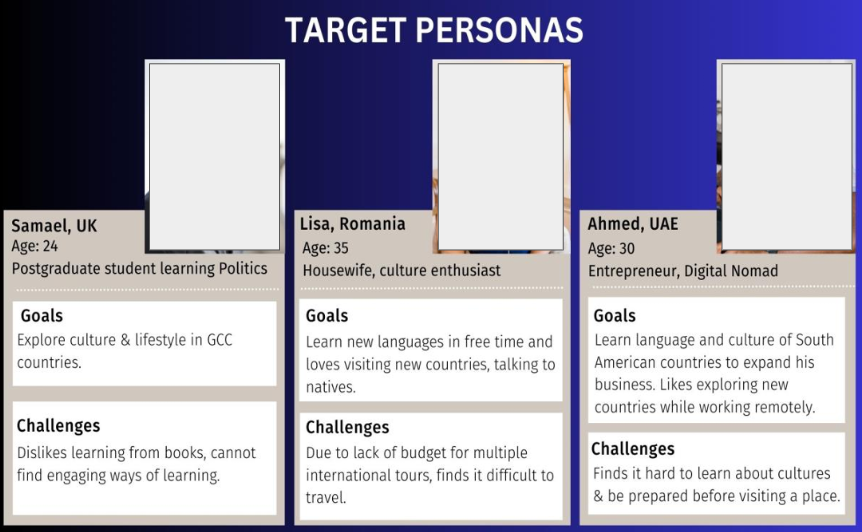
Let’s look at the example of Cosmic, a language and culture exchange website I created, understanding its significance in this globalised world thriving on cooperation between countries and cultures.
Cosmic’s mission is to connect people from around the world, making language learning and understanding different cultures easier. According to BusinessofApps, language learning applications have generated a combined revenue of 8.2 billion USD in 2021, a 32% annual increase. Applications like Duolingo, have succeeded through gamification approaches. Research also shows that AR has had immense value in the exploration of geographic and cultural aspects of an environment (Javornik, 2016). Hence, combining the proven success of strategies like gamification and storytelling with AR, Cosmic can gain a competitive advantage.
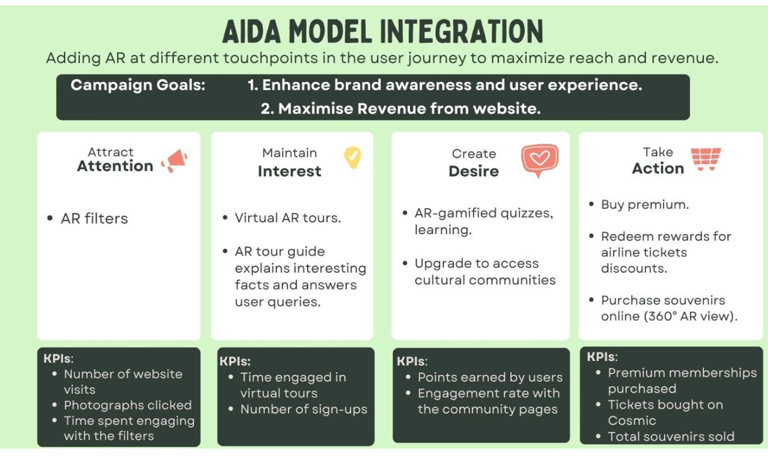
Using the AIDA model, the following strategy was created to leverage AR for digital marketing by introducing AR functions at ideal checkpoints in the customer’s journey, achieving customer conversion at the end of the funnel.
Step 1. Attract Attention
Publishing AR filters on Cosmic’s website, and promoting the campaign on social media can attract customers to Cosmic. The user can choose a country (suggested based on their searches), and an appropriate backdrop of cultural significance. They can upload the selfies clicked with these AR generated ‘monuments’ on social media, spreading the word about Cosmic.
Step 2. Maintain Interest
Brand experiences are more satisfactory for the customer if it helps gain useful knowledge in addition to entertainment and interactivity (Brannon Barhorst et al., 2021). Hence, creating an experience benefitting the user is essential to retain their interest. A prompt on the website invites users for a virtual tour, with iconic elements from the city offering fascinating educational content.
For instance, a trip through Tokyo, would generate an AR representation of the Shinkansen bullet train in Japan, taking the user through Tokyo, explaining facts such as how the Tokyo Tower was built to resemble the design of the Eiffel Tower in France. The user is prompted to sign up for a free account on completion of the trial experience to gain access to the full tour.
The AR tour can be created by integration with Google’s ARCore Geospatial API, for location context, and Unity for creating AR elements, along with a fine-tuned GPT model powered by the OpenAI API that can answer tourism related questions from the user (Yuen, 2023). If the primary goal of the marketing campaign is to create awareness, then prompting sign up here, will create within the user a desire for the full experience and lead them to take action at this step. However, since the focus is also on maximising revenue, the desire and action stages are further expanded.
Step 3. Create Desire
Now, the user has to be persuaded to own the product.
Gamification of the website experience can be achieved with AR games and quizzes, bite sized language lessons, and rewards for completion. Letting premium users redeem rewards for discounted airline tickets from our partners will further fuel the desire to obtain a paid membership.
Based on the success of similar applications, the best way of using AR would be by incorporating psychological aspects like ‘loss aversion’ by encouraging the user to maintain streaks, or ‘steady progression’, making learning possible in incremental ways (Tamang, 2023). With a paid membership, the user can join a ‘cultural community’ of their choice and interact with others, which is highly useful for travel enthusiasts. This exclusivity and rewards offered can make the users pursue the paid membership.
Step 4. Take Action
On buying the premium, the user can learn the language directly from a native speaker, and continue to gather points from the games to buy discounted airline tickets later, offered by airline partner companies. Cosmic also sells souvenirs from all around the world. Enabling an AR based pre-purchase product visualisation for souvenirs sold on the website, to get a 360 degree view enhances user experience. Revenue obtained from these can be monitored as a Key Performance Indicator (KPI) as well.
IS AR ENABLED DIGITAL MARKETING THE RIGHT PATH TO PURSUE?
Building AR solutions require ample investment in the right hardware and software. Slower processing and network communication delays can result in latency affecting user experience and hindering them from using the AR offerings at all. Hence, it is also imperative to address these challenges and understand the target customer, since they should be tech-literate and have access to AR compatible devices.
AR gives a ‘vivid’ experience with its capacity to produce a sensorially rich environment that can elevate the user’s perception of information quality and can stay in their minds longer, thereby influencing their ‘cognitive processing’ (Brannon Barhorst et al., 2021). While this makes a memorable experience for the user, the campaign success still depends on content quality. If the customers can’t connect, user satisfaction cannot be retained after the initial novelty has passed. Thus it is important to address actual customer needs and retain their interest to avoid this classic case of marketing myopia.
AR can have different implications in different fields. Research states that using AR tools influence people’s core beliefs about themselves, creating a phenomenon called 'augmented self’, which might negatively impact the psychological wellbeing of some users (Javornik et al., 2022). Especially in the beauty industry or social media, where this could have detrimental effects to the user, unrealistic standards must not be promoted and mental health experts or human computer interaction design experts must be involved in the design process while creating AR filters (Javornik et al., 2022).
Excessive use of AR applications would also lead to user fatigue. While AR has a promising future in digital marketing, if wearables like the Google Glass are welcomed back, users would have a hard time dodging the AR advertisements that swamp their daily lives. As a digital marketer, it definitely helps meet the goals of increasing brand awareness and outreach. However, with increasing adoption of wearable gadgets mixing elements of extended reality (AR/VR), would a world where advertisements overflow from the virtual space to the real world, replacing every ordinary experience, be ideal?
While this future is not far away, with enough ethical considerations in place, things would be under control. The British Standards Institution have also called for guidelines for a safe set up of AR/VR with recommended periods of safe usage, age limits, and content warnings (House of Commons, 2019). Since AR requires frequent access to the user’s camera and location data, it is mandatory to address potential risks to the user’s privacy. Companies using AR should be aware of, acknowledge and attend to the risks accordingly since ethical considerations should not be entirely forgotten in the race to amplify the usage metrics.
With the right balance of powerful technology, ethics, and creative ways of digital marketing, AR can truly take digital marketing to new bounds!
References
1. Blippar (2022) Netflix - AR Creations.
2. Brannon Barhorst, J. & McLean, G. & Shah, E. & et al. (2021) Blending the real world and the virtual world: Exploring the role of flow in augmented reality experiences. Journal of Business Research, 122 : 423–436. doi:10.1016/j.jbusres.2020.08.041
3. Dervişoğlu, Y. (2022) 2023 Digital marketing trends and predictions.
4. House of Commons (2019) Immersive and addictive technologies, London.
5. Javornik, A. (2016) The mainstreaming of augmented reality: A brief history, Harvard Business Review
6. Javornik, A. et al. (2022) Research: How AR filters impact people's self-image, Harvard Business Review.
7. Scholz, J. & Smith, A.N. (2016) Augmented reality: Designing immersive experiences that maximize consumer engagement. Business Horizons, 59 (2): 149–161. doi:10.1016/j.bushor.2015.10.003
8. Shah, M. (2020) How augmented reality (AR) is changing the Travel & Tourism Industry.
9. Tamang, R. (2023) UX and gamification in Duolingo, Medium. UX Planet.
10. VSLB Inc. (2022) How to use AR as an art of storytelling in marketing?
11. Yuen, hiukim (2023) ARound, Devpost.